

Data Center Debacle
The hidden cost of the AI boom falls on the communities least likely to benefit.

By Harral Burris
Along the steel-producing corridor that circles the Great Lakes, and the refinery and chemical complexes that line the Louisiana and Texas Gulf coasts, the relationship between industry and local communities has always been complicated. Steel mills and refineries brought pollution, land degradation, environmental damage, and ill health for workers and their families. They also generated good jobs, tax revenue, ports, infrastructure, and pride in service to the nation. Gary, Indiana, and Beaumont, Texas, may not be garden spots, but they were crucial for American industrial dominance in the 20th century.
The result was an industrial bargain: local communities absorbed the burdens of heavy industry and refining in return for good-paying jobs, better schools, and lower property taxes. In the age of AI, the modern world is now testing that bargain.
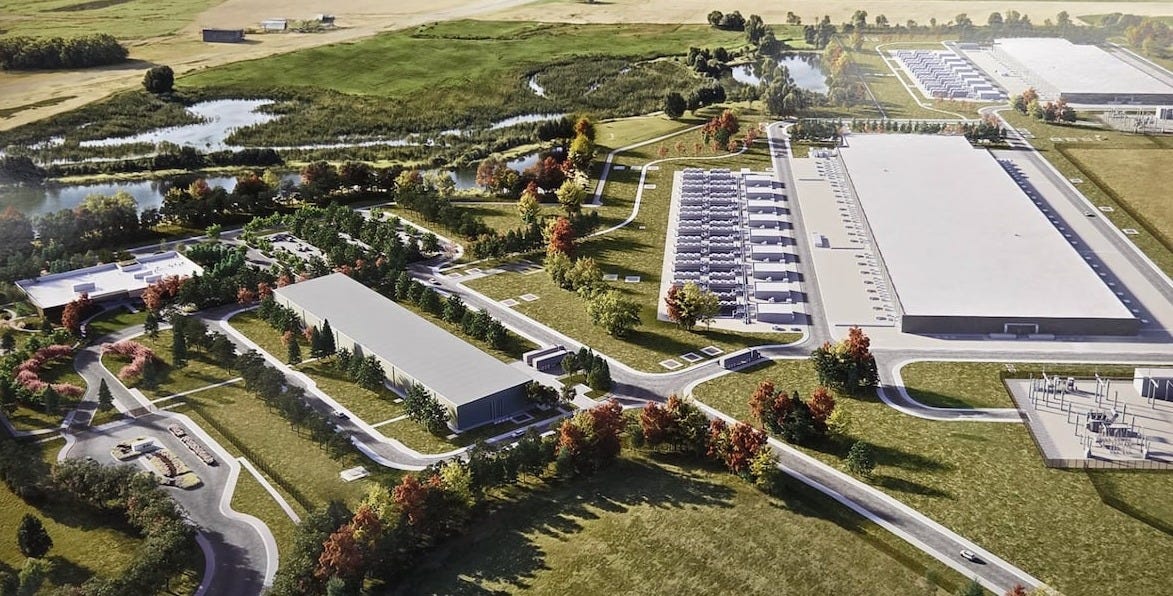
Data centers are the new heavy industry. They are strategic, capital-intensive, power-hungry operations whose importance extends far beyond their physical location. They arrive wrapped in the language of clean technology, cloud computing, and the AI revolution. Early-adopting communities are discovering that data centers behave less like clean-tech office parks and more like the polluting infrastructure they thought they had expelled.
AI promoters describe the technology as weightless, digital, and borderless. It is none of those things. Claude cannot work without massive amounts of electricity, water, land, semiconductors, cooling systems, fiber networks, transformers, and, most importantly, local political permission.
Like industrial facilities and refineries, data centers depend on a supply chain. Instead of iron ore, coke, and crude oil, they need chips, servers, copper, cooling systems, and fiber optics. They require enormous fixed investments and inevitably reshape the communities around them.
But the bargain between the AI industry and local communities is weaker. Steel mills and refinery complexes employed large numbers of workers and created industrial ecosystems as those workers spent their wages. Data centers require major upfront investment but relatively few permanent workers once construction is complete. That does not mean they lack value, but it does mean they offer far less value to people in the community.
A community asked to host a steel mill, smelter, or refinery could expect jobs, rail lines, and a growing tax base. A town that gets a data center is more likely to see higher electricity costs, construction traffic, humming equipment, water shortages, and perhaps some tax abatement, but no durable employment base. Landowners may see lower taxes, but there will be no new jobs for the working class.
Data centers are the factories of the AI age. They will help shape the nation’s future, from scientific research and healthcare to defense capacity and financial markets. But the new lords of the information age must strike a bargain with the people whose land and resources they need to create that wealth. Their long-term success depends on whether they can build the necessary facilities without betraying the communities asked to host this brave new world.
Google’s parent, Alphabet, recently announced an $80 billion equity raise for data centers, even though construction faces delays due to supply-chain backlogs, permitting hurdles, and power shortages. Google is not alone; AI providers are committing unprecedented sums to the build-out of data centers.
The major AI players have all recently announced significant upward revisions to their capital-expenditure forecasts, as the AI race requires constructing massive, hangar-sized facilities packed with servers, networking hardware, and cooling systems. Microsoft, Alphabet, Meta, and Amazon collectively devoted $410 billion to capital expenditures last year and are expected to spend more than $650 billion this year.
Securing the capital is not the problem; deploying it quickly and effectively is the issue. A JPMorgan analyst found that more than 60% of data-center capacity planned for completion in 2027 has not yet broken ground.
Finding enough electricity is another major constraint. These massive centers can draw as much power as a midsize city and threaten to strain the grid during periods of peak demand on hot days. No one knows the total power demand or how much load will ultimately be connected, so the permitting process is effectively at a standstill. No politician wants to be blamed for allowing Amazon or another hyperscaler onto the local grid, only to watch the region suffer blackouts on hundred-degree days.
The demand for computing power has become so great that the Federal Energy Regulatory Commission approved Constellation Energy’s request to fast-track the revival of the Three Mile Island nuclear plant in Pennsylvania. The plant has been mothballed since its sister reactor melted down 47 years ago, nearly causing a catastrophic nuclear accident. Microsoft has entered into a 20-year contract with Constellation to buy all the electricity produced by the 835-megawatt reactor. For context, nearby Pittsburgh requires roughly half that much power.
But there is only one Three Mile Island to reactivate. For most data centers, the solution is to build dedicated on-site gas-turbine generation. The more aggressive companies are betting on nuclear power, including traditional large-scale reactors and smaller ones now under development by a range of companies and startups.
Building new power generation comes with its own problems. Nuclear projects take years to come online, and delays in obtaining gas turbines and transformers have also slowed data-center construction.
The public is waking up to the fact that what is good for Microsoft and Google is not necessarily good for everyone else. According to the United Nations, the environmental footprint of data centers already rivals that of some of the world’s largest countries, and their water and energy use, as well as their pollution, are projected to double in the next four years.
According to the UN report, global data centers used 448 trillion watt-hours of electricity last year, more than all but the 10 largest countries. That electricity generated about 200 million tons of carbon dioxide and consumed 1.2 trillion gallons of water. Under current growth projections, by 2030, data centers will account for 3% of global electricity use and produce 440 million tons of CO2.
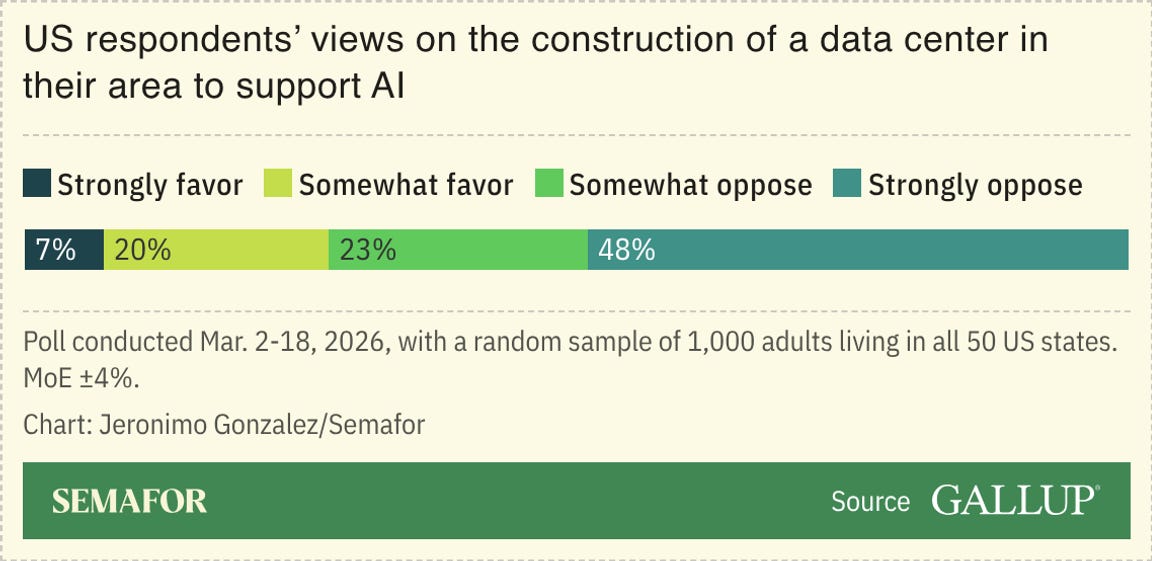
The growing backlash against data centers is a warning sign. For people living near proposed or newly built facilities, it is becoming clear that Jeff Bezos, Mark Zuckerberg, and their peers are not their friends. Across the country, local and state governments are imposing moratoriums, considering restrictions, or rejecting proposed projects outright.
This is not just a NIMBY problem. The AI economy is expanding faster than the civic bargain needed to sustain it. The politics are bipartisan because the concerns are real and local: electricity bills, water use, land use, noise, and grid reliability. A farmer worried about water availability, a homeowner dealing with constant noise, and a retiree facing higher electricity bills may have different politics, but they can all agree on one thing: they do not want a new data center project in their backyard.
The political question is not whether data centers should have electricity and water. The question is who should pay for the generation, transmission, reliability, and water infrastructure they require: Jeff Bezos or you and your next-door neighbor?
If AI companies expect ordinary citizens to foot the bill, the backlash will intensify. Households should not be asked to subsidize the grid upgrades and new water facilities needed to support a data center. The companies that benefit should contract for the power and water they need. After all, they are the ones profiting from these electricity- and water-hungry facilities that create relatively few local jobs.
American politicians are worried about AI competition with China and are risking trade wars to keep cutting-edge semiconductors out of Beijing’s hands. But if the U.S. cannot reach an agreement between domestic AI companies and the communities that host their data centers, China may win anyway.
So here we are: Humans have created machines capable of writing poetry, passing bar exams, and diagnosing rare diseases, and yet we can’t seem to figure out how to plug the damn things in. That is an apt testament to the human condition.
Love your pithy synthesis of the problem: "The AI economy is expanding faster than the civic bargain needed to sustain it."